
Torge Goderstad: Blending Sound and Site in New Project at Snug Harbor
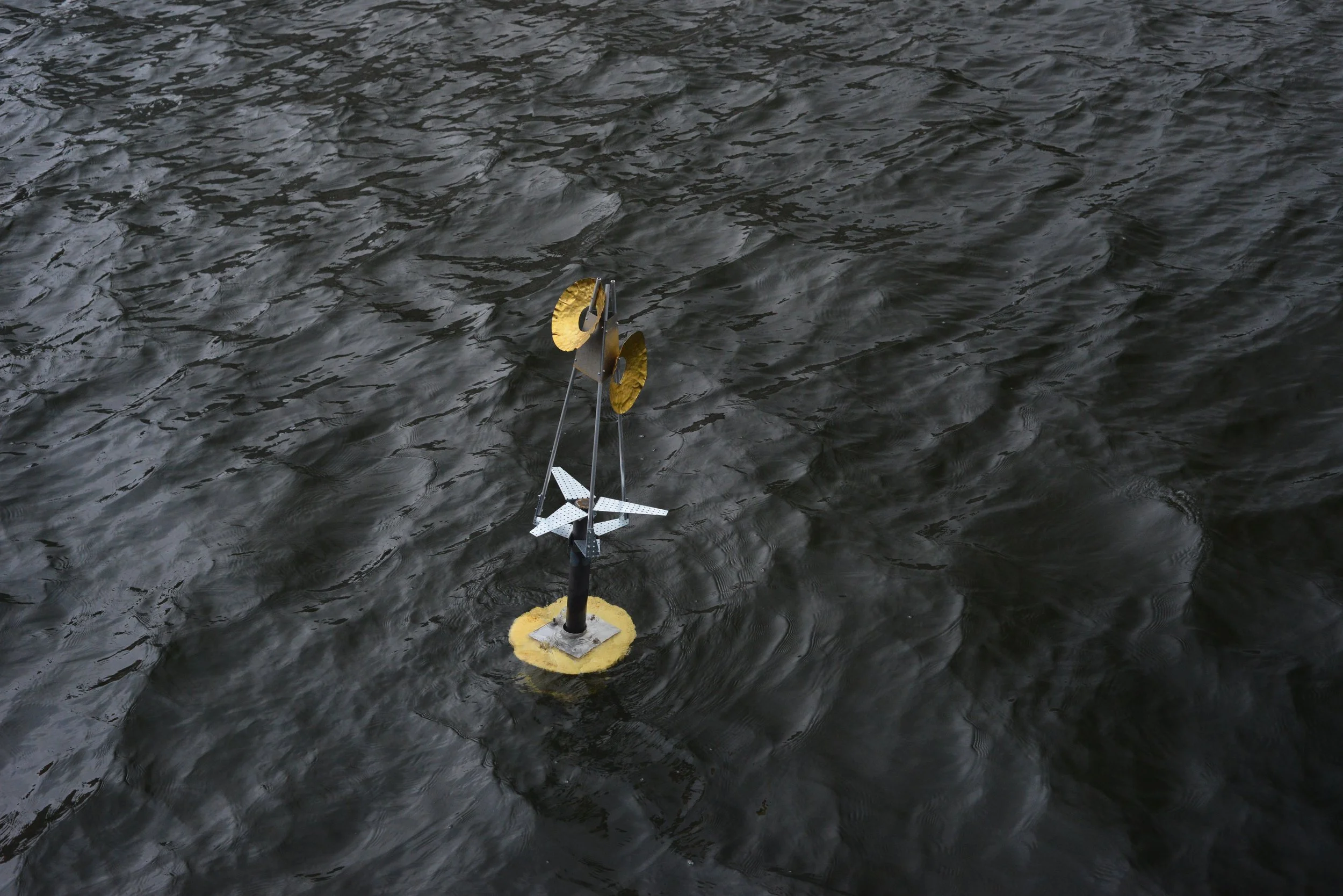
Strange Beacon by Torge Goderstad.
Torge Goderstad (b. 1995) is an American artist working with composition, space, sculpture, and instrument building. He composes pieces for his instruments and sculptures that are performed, while also allowing his works to function as standalone sculptures and installations. He lives in New York City and is also active in Berlin.
Goderstad is a current PASS (Performing Arts Salon Saturdays) artist in residence at the Newhouse Center for Contemporary Art at Snug Harbor. In anticipation of his upcoming PASS performance on May 30, 2026, at 2 PM, Goderstad shares interesting tidbits about his work and process in an interview with PASS curator Melissa West.
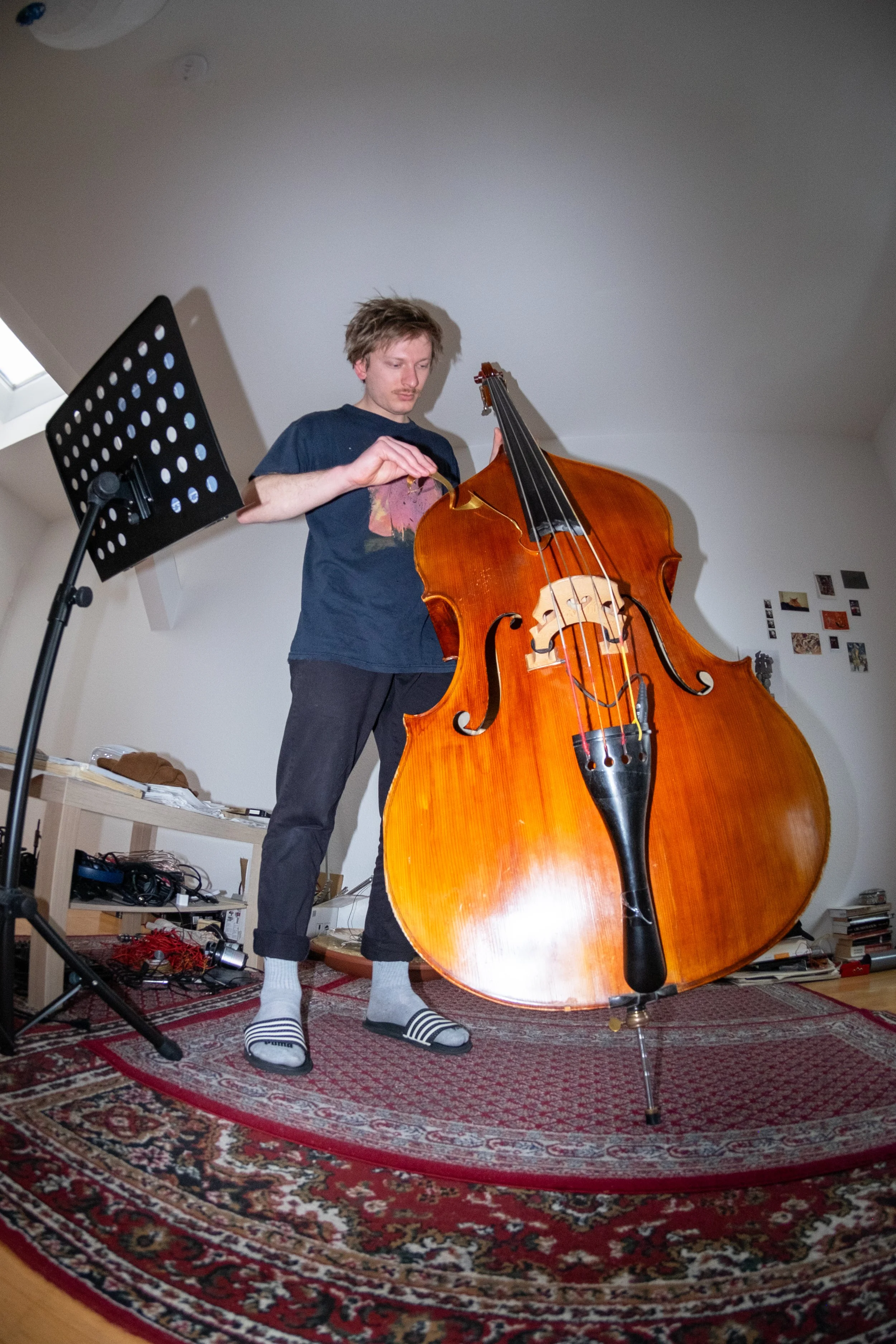
Torge Goderstad with upright bass.
How did you first get into music? You move between being an artist, composer, and sculptor. What led you to explore these forms of expression?
When I was growing up, music was just something that was always happening. There was always something playing on the radio, in the car, at home when I was growing up. I first really got into instrumental music when I was young and heard my first “instrumental” song (I wish I remembered the name). I was completely confused that there were no vocals, and I didn’t understand how it could be a “song” without vocals—this really fascinated me, and I think it opened a door early on for being more inclined to instrumental music.
I would mainly say composers such as Harry Partch and instrument builders such as the Bechet Brothers have been very influential on me.
I see instrument building as an area where music and sculpture fully intersect. The introduction of a physical element (custom-built instrument) really opens the door for the composition to take a place in the world of objects, and what the instrument is made from can be thought of as another part of the story or idea you are trying to convey with the composition. As someone who is interested in site-specific sound work, this is pretty important for me. It opens the door for linking the composition and the instruments it’s played with, being directly tied to the site you are interrogating.
Who are some of your musical and artistic influences? When I listen to your work, I hear traces of jazz and the avant-garde. Who were some of the artists you grew up listening to?
I like a lot of different music, so my taste and influences are pretty much all over the board. I would say three main influences would be Melvins, Wilbur Ware, and George Crumb. All three of those artists have influenced me in some capacity when it comes to music and composing. There are a ton of other ones, too, but those three are some of the first that come to mind.
Growing up, I listened to a lot of 90’s grunge—SoundGarden, Nirvana, Melvins, Meat Puppets. I still listen to a lot of that music.
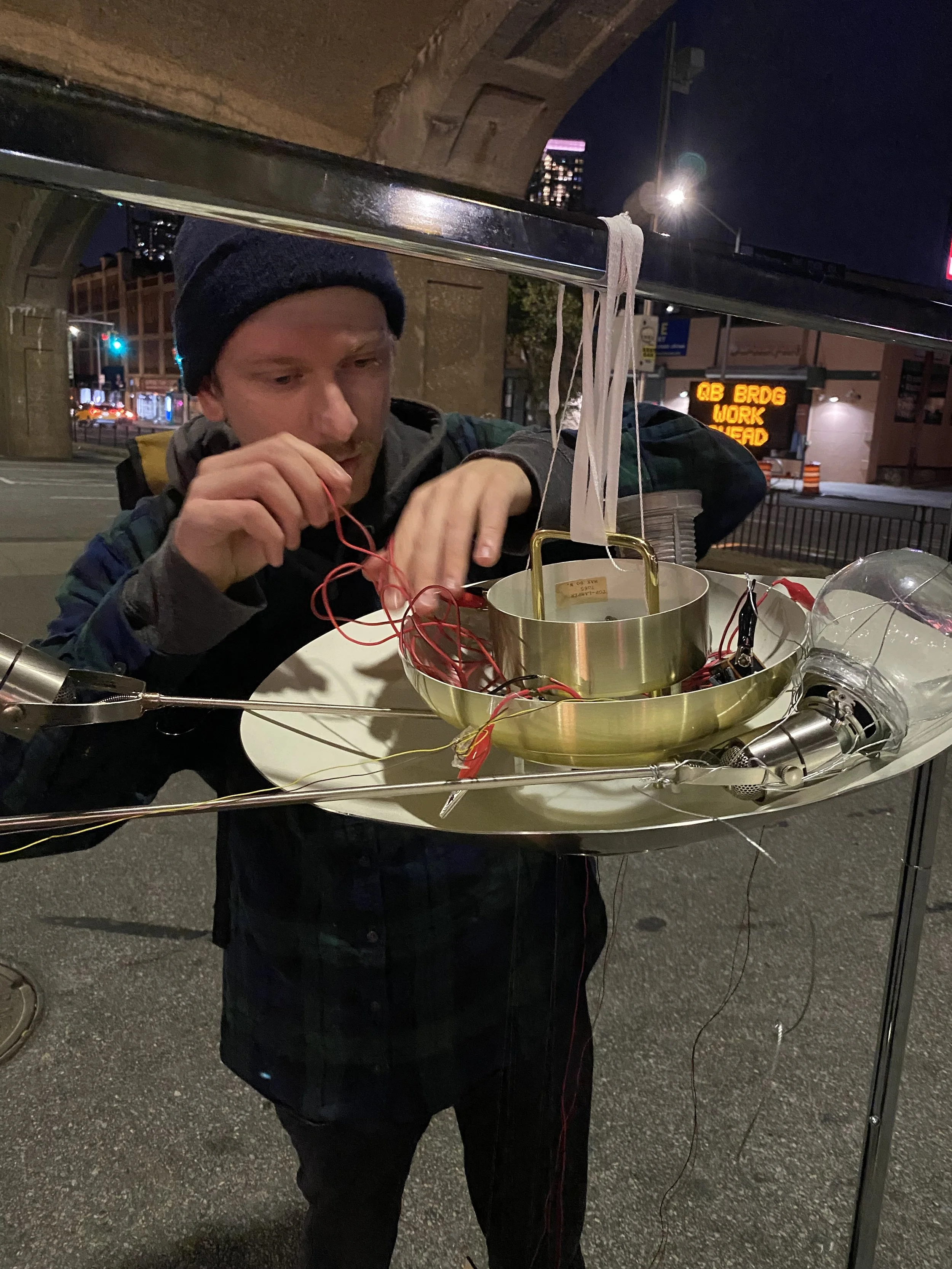
Working with wires on location in Queens.
How do you begin a composition? I know you work with site-specific locations and often incorporate field recordings into your projects. Do you typically begin from a conceptual place, or are you starting with the music itself?
Lately, I have been starting from more of a conceptual place. When I start a piece, I usually start with the idea first, and then I shape the music to fit within that idea. I use this as a constraint to sort of limit the music and keep it specific to what I am interested in.
When I was studying composition, I had this idea of “innovation through limitation” sort of drilled into my brain, and I found it very useful. I now think of the starting concept/idea as the limitation for the music, and then I try to shape the composition around those ideas. The music serves the idea, not the other way around.
You’re currently an artist in residence at Snug Harbor, working on a new project, Lines in the Water. You describe this work as sitting “between two realities of maritime activity. On one side, the use of objective data such as currents, radio alerts, and weather forecasts for navigational purposes. And on the other side, an abstract awareness of the unknown, and the mysticism that has been the source of countless sea stories.” How did this idea come to you?
I was mostly thinking about how marine sites have changed over time, and how instrumentation used in navigation has evolved from devices more reliant on a person or sailors’ skill/knowledge (azimuth, sextant) to something that can instead be more easily quantified and interpreted by a computer for navigation.
The contrast between those two things is pretty interesting to me, and it led me to think about the ways that humans try to quantify the ocean. We make these “Lines in the Water."
What does a typical day in your artist residency look like?
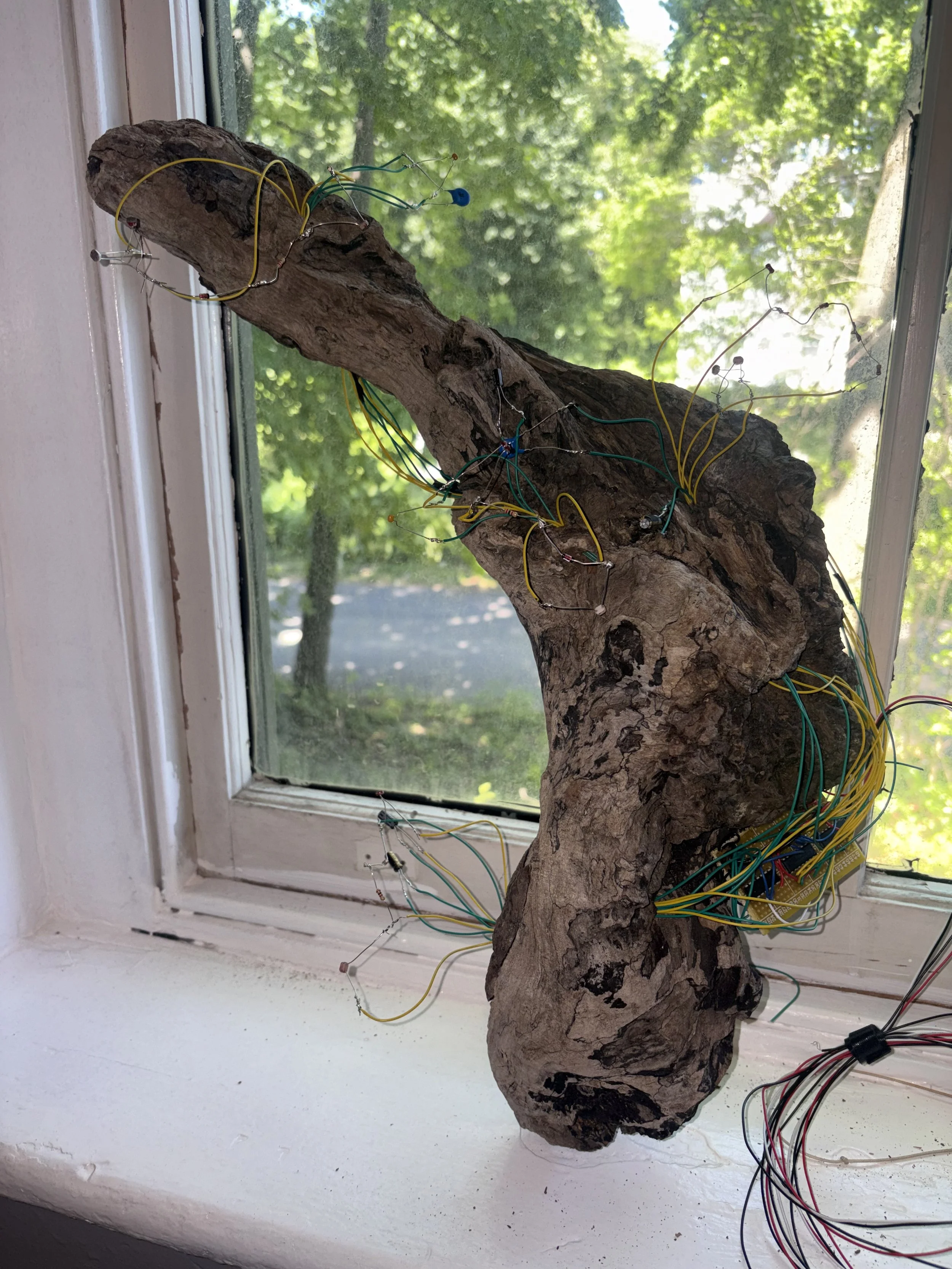
Driftwood synth created by Goderstad, image captured in residency cottage at Snug Harbor.
A typical day includes a ton of coffee, writing music, wiring circuits into driftwood, figuring out spatial-audio technical difficulties, and scavenging the shores of the Arthur Kill, right across from Snug Harbor. If you consider Marine trash treasure (which I do), it is an absolute gold mine.
I’ve been spending a good amount of time on that shore making recordings of all numbers of things. My favorite moment so far from the residency has been hanging out on the shore, and one of the saxophonists in the performance (Kaelen Gandhi) just started reflecting his soprano off the big container ships passing by. It sounded great. I hope the people on the ship could hear it.
While researching this piece, you visited Robbins Reef Lighthouse in the middle of New York Harbor. What were you able to glean from that visit?
Visiting Robins Reef was pivotal for the residency direction. Two things specifically affected me pretty significantly. The first was a buoy near the lighthouse we passed on our way out. This was a massive buoy covered in rust patterns shaped by the waves, and in the middle of the buoy was a huge number “4”. This, to me, was exactly what I am trying to get at in this piece.
The wave-shaped rust patterns indicate a constant force, eroding the buoy. The ocean beating it down until it fully dissipates into nothingness, but here is this big “4” on the side which is the categorization side of a human trying to impose their own navigational/segmented idea onto something so endless and eternal as the ocean. A “Line in the Water."
The second thing was on the lighthouse platform- an iron railing that had been completely carved from the wind and sea. It was in such a state of decay that the iron resembled bark on a tree. Seeing that “artifact,” or evidence of the long history next to the lighthouse, undergoing restoration, had me thinking about how erosion and decay can also make way for new spaces of growth. This has impacted how I will be approaching a score in the performance—as an artifact susceptible to erosion—and what can be created when parts of the composition are dissolved or eroded.
Much of your sonic work is integrated with the built environment and its histories, such as Two Islands, a piece that involves field recordings and improvisation, and Reflections for Woodwinds, Cymbal and Concrete, which takes place under the arches of the 7 train in Queens, NY. What draws you to a place? How do you navigate the particularities of a site, such as its acoustic properties, interactions with people and wildlife, or gaining access to a remote location?
For “Reflections for Woodwinds, Cymbal and Concrete,” I was honestly drawn to the arches because I live two blocks from them. On my way to work, I will sometimes see groups of kids yelling, clapping, etc., to listen to the echoes, and I was inspired by how this crazy acoustic reverb is so accessible to anyone who just happens to live nearby or takes a train ride over. It felt like here is this amazing acoustic quality in the middle of a neighbourhood and reminded me a lot about R. Murray Schaffer’s ideas relating to keystone sounds defining a certain place/time period. I think you could say “7 train reverb” is Sunnyside’s keystone sound.
I was also drawn to it for composing because the site naturally has this spatial element to it, and this had me thinking a score similar to a map could be interesting here, because as you move through the space, the strength of the reverberant quality shifts. As I looked more into it, the MTA archive department was kind enough to show me old engineering drawings of the tracks, and I used this to ultimately influence notation for the piece as well.
In addition to your musical compositions, you also build instruments and sculptural works, such as Sirens in the Fog, which explores the fog horn and its function as an audible guide into obscurity or, as you describe it, loss of perception. Tell us a little about your practice of building/sculpting sounds into objects. How does this inform your musical work?
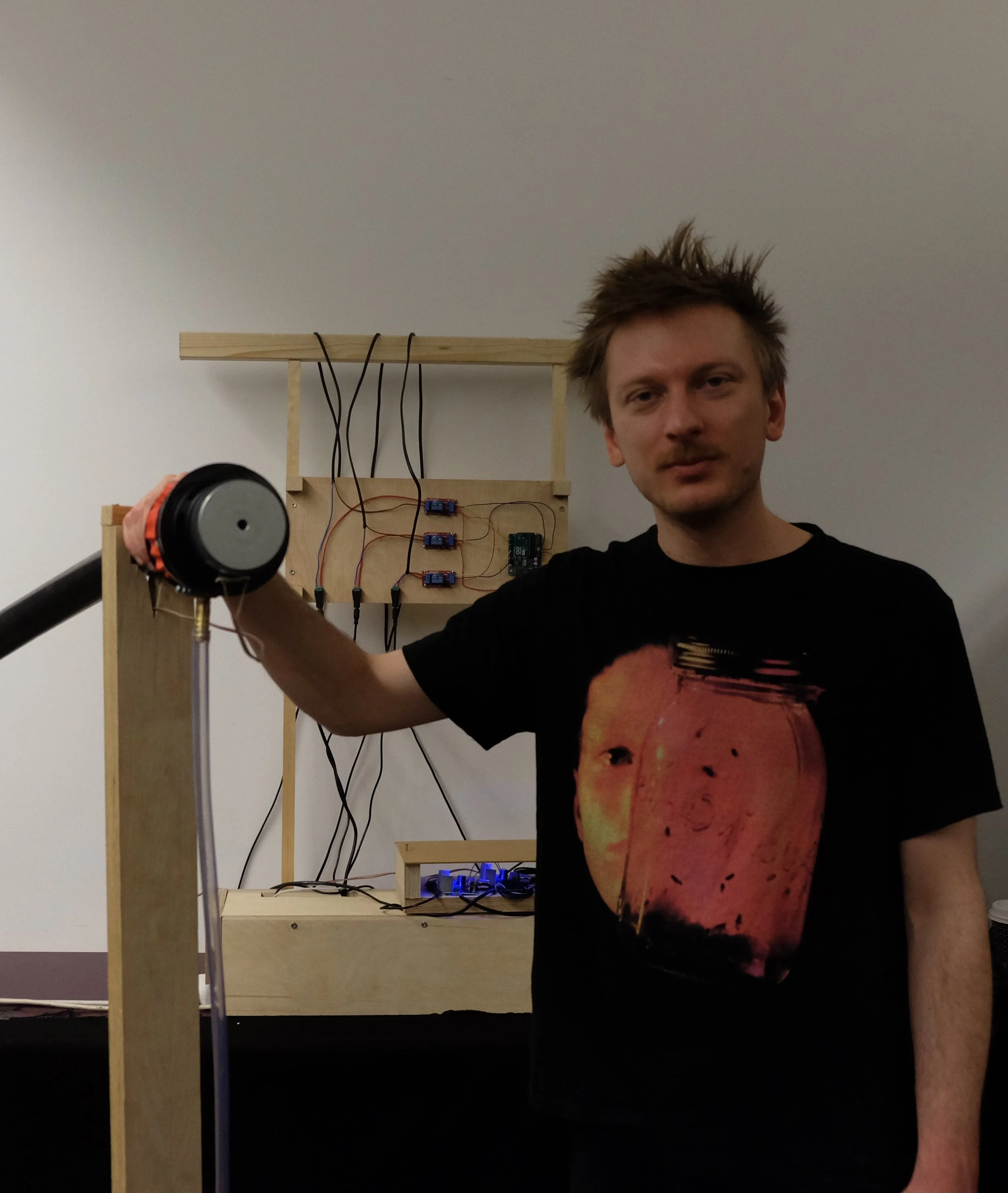
Goderstad with horn.
One thing I really enjoy about building instruments and sculptures that have some sonic quality to them is that the acoustic properties are, of course, completely dependent on the form of whatever you are making.
It becomes an interesting balance, because you may make a decision that aesthetically looks good, but this might change the sonic character of the sculpture/instrument.
Through the process of making these objects and discovering what acoustic properties they have, it kind of limits you when you compose for other, more conventional instruments alongside them.
What can audiences expect to see or hear in Lines in the Water (without giving too much away!) on May 30 at Snug Harbor?
A couple of pieces, all dealing with different things that I’ve found interesting while exploring and recording different sites throughout New York Harbor.
One piece is for two horns and bass with field recordings I’ve made at Robins Reef Light and the Staten Island Boat Graveyard.
Another short piece utilizing a light-based driftwood synth sculpture I’ve been working on and an electronic saxophone.
And possibly a score rusting in real time (although those logistics are still being finalized).
Learn more about Torge Goderstad by visiting: https://www.torgegoderstad.com/

Melissa West is a choreographer and curator based in Staten Island, NY. She is the Director & Senior Curator of the Newhouse Center for Contemporary Art at Snug Harbor, and co-founder of the Shaolin Art Party. West is dedicated to creating local opportunities and innovative cultural experiences for artists and audiences alike. mwestdances.nyc